
Why Is Medicai the Best for High System Uptime?
Quoted in this article$2,000 to $18,000
Many hospitals lose hours each month when imaging systems go offline during peak consults, forcing staff to reschedule patients and chase down scattered files. These outages often trace back to single-region servers that fail without fast failover or clear recovery paths. The article shows which infrastructure choices keep data always available and how Medicai builds that uptime into its platform.
By the end you will know what separates stable multi-region clouds from the rest, which backup steps actually shorten recovery time, and whether Medicai's Imaging Infrastructure as a Service meets your hospital's uptime needs.
What Is Medicai?
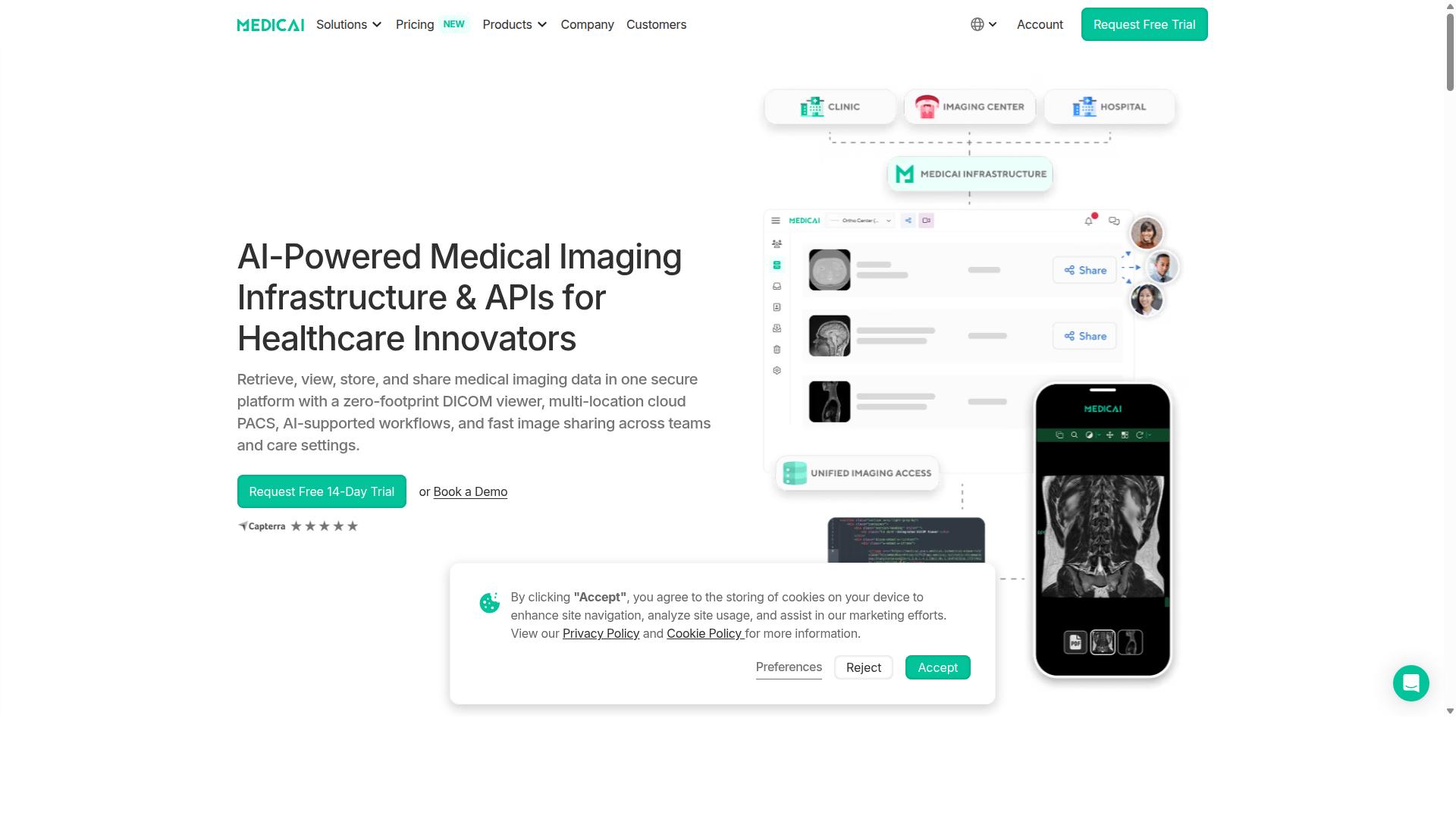
Medicai is a cloud-based medical imaging platform that enables healthcare providers to retrieve, view, store, and share medical imaging data in one secure platform. The platform serves hospitals, clinics, and radiology practices that need reliable access to diagnostic imaging without local hardware constraints.
Core capabilities include a zero-footprint DICOM viewer that runs in standard web browsers. This approach eliminates software installation while maintaining full diagnostic image quality across different devices and operating systems.
Medical facilities access on-demand retrieval that pulls studies from any connected location without manual intervention. The service supports multi-location cloud PACS environments where imaging departments at separate sites can access unified patient records.
Secure sharing functions allow authorized users to exchange studies across care teams while maintaining compliance with data protection requirements. These features support AI-supported workflows that help radiologists process imaging studies efficiently.
Healthcare organizations use Medicai as Imaging Infrastructure as a Service. This model replaces traditional on-premises servers with managed cloud resources that scale according to clinical demand patterns.
Why Medicai Delivers the Highest System Uptime
Medicai maintains high availability through multi-region deployment, Kubernetes orchestration, and automated failover systems. This architecture supports continuous operation across medical imaging workflows where downtime can affect patient care and data integrity.
The SLA target represents a formal commitment between the service provider and users. This agreement defines measurable performance standards and outlines compensation procedures when targets are not met.
Real-time health checks monitor system components across all infrastructure layers. These checks detect anomalies in container performance, network connectivity, and storage systems before issues impact users.
Automated recovery workflows respond to detected problems within seconds. The system restarts failed containers, redirects traffic to healthy nodes, and restores service without manual intervention from operations teams.
Container orchestration manages load balancing across Microsoft Azure, Amazon AWS, and Hetzner data centers. This distribution prevents single points of failure and maintains performance when regional issues occur.
Kubernetes clusters handle traffic routing based on current load conditions and geographic proximity. The platform automatically scales resources during peak usage periods in radiology departments and diagnostic centers.
Medical imaging systems require consistent access to PACS and DICOM data for accurate AI diagnostics. High system uptime ensures radiologists can review studies without interruption regardless of time zone or facility location.
Network resilience features include redundant connections between regions and backup routing paths. These measures protect against fiber cuts, power outages, and localized infrastructure failures that could otherwise disrupt service.
Data centers operate with independent power systems, cooling infrastructure, and internet providers. This redundancy ensures that the failure of any single facility does not compromise overall system availability.
Performance optimization through container orchestration reduces latency for users accessing studies from different locations. The system maintains consistent response times even as data volumes grow in healthcare organizations.
Key Features and What Makes Medicai Stand Out
The platform's architecture combines HIPAA/GDPR-compliant encryption, AI-ready APIs, and integrated workflow tools to deliver secure, continuous medical imaging operations.
Medical imaging platforms must handle large data volumes without interruption. Medicai processes more than 50 million API transactions each year and manages over 1.7 million studies in storage while supporting 10,000 active doctors across 70 clinics and hospitals.
Security standards matter for uptime. The system follows OWASP guidelines, maintains HIPAA and GDPR compliance, and offers FDA and CEE cleared viewers to protect data integrity during every transaction.
Multi-Region Cloud Infrastructure
Multi-region deployments on Microsoft Azure, Amazon AWS, and Hetzner keep latency low while scaling storage and compute on demand.
Kubernetes-based container orchestration manages workloads across these three providers. When demand spikes, the system automatically distributes traffic to maintain performance and prevent bottlenecks.
Scale becomes evident in the numbers. Medicai handled 50 million API transactions and created 300,000 visualizations of DICOM studies in the last year alone, proving the infrastructure supports heavy clinical use without downtime.
Container orchestration also simplifies updates. New features or security patches deploy across regions without service interruption, keeping radiology workflows running smoothly.
Backup and Disaster Recovery
Automated nightly backups and cross-region snapshots provide fault-tolerant redundancy for every DICOM study stored.
The Vendor Neutral Archive includes backup and disaster recovery as a core service. Encryption protects data both at rest and in transit, meeting compliance requirements while preventing data loss during outages.
Cross-region snapshots create multiple copies of imaging studies. If one data center experiences issues, another region can serve the same files immediately, preserving access for radiologists and referring physicians.
Regular backup cycles and encrypted storage together deliver reliable protection. Clinics and hospitals using Medicai maintain continuous access to patient imaging even when unexpected events occur.
Pricing and Plans
Starter and Standard plans scale storage and connectivity with transparent monthly fees. Organizations can choose the tier that matches their imaging volume and connectivity needs. The two published tiers both include HIPAA and GDPR compliance as standard.
Starter costs $249 per month and includes 500 GB of cloud storage with unlimited user accounts. This tier provides no connected locations and suits smaller practices that need reliable access to medical imaging without additional infrastructure.
Standard costs $749 per month and includes 2 TB of cloud storage with unlimited user accounts. One connected location is included, making this tier suitable for practices that want to link imaging equipment directly to the platform.
Yearly billing offers 15 percent savings on both tiers. Starter drops to $209 per month and Standard to $639 per month when paid annually. A 14-day trial of Starter features is available without requiring a credit card.
Enterprise plans provide custom pricing with multiple connected locations and additional external sites. DICOM Gateway setup costs $1,000 one time per location. Per-study pricing is also available for enterprise customers.
Trust Signals
First sentence: HIPAA and GDPR compliance plus FDA and CEE clearance of the viewer provide third-party validation of Medicai's security controls.
These certifications confirm that the platform meets strict healthcare security standards. Medical imaging providers gain confidence when they see documented compliance.
Medicai processes 1M+ studies each year and stores 1.7M+ studies at present. These usage metrics reflect real-world reliability across diverse clinical environments.
The platform also records 300k+ visualizations of DICOM studies in the last year and handles 50M+ yearly API transactions. High transaction volumes demonstrate consistent availability for radiology workflows.
Seventy clinics and hospitals plus 10,000+ active doctors rely on the service daily. This adoption base shows that institutions choose Medicai for continuous operation.
Microsoft Azure partnership supports the infrastructure while OWASP security guidelines guide ongoing development. Combined safeguards protect data integrity during medical imaging exchanges.
Who Should Use Medicai
Hospitals, imaging centers, and specialty practices across orthopedics, neurology, oncology, cardiology, and additional fields need a unified, secure imaging platform.
Healthcare providers of every size rely on continuous access to medical images. Medicai delivers this access through its global online availability, helping facilities avoid workflow interruptions that affect patient care.
The platform supports virtual care providers and telemedicine platforms that require reliable DICOM routing. Real-time image sharing becomes possible without downtime concerns that commonly affect on-premise systems.
Teleradiology services and tumor boards benefit from Medicai's cloud infrastructure. These groups coordinate across multiple time zones, and consistent uptime ensures every participant can review studies when scheduled.
Clinical trials and medical education organizations also depend on uninterrupted data access. Medicai's design accommodates these groups by maintaining high system uptime across its global network, allowing researchers and students to retrieve imaging data without delay.
Patients gain direct entry through the Patient Portal. This feature extends the same reliability standards to individuals who need to view their own records, closing the gap between clinical systems and personal health management.
Specialties such as ophthalmology, ob-gyn, pulmonology, dentistry, and gastroenterology receive the same uptime protections. Each department can access studies on demand, supporting both routine workflows and urgent consultations.
Personal injury lawyers integrate imaging data into case preparation. Medicai's consistent availability removes the risk of missing critical files during discovery deadlines or settlement negotiations.
Final Verdict
Medicai's combination of high uptime, scalable multi-region infrastructure, and transparent pricing makes it a reliable choice for healthcare providers worldwide.
The platform supports medical imaging workflows and PACS systems while maintaining continuous operation across its cloud infrastructure. Healthcare facilities benefit from fault tolerance and redundancy features that keep radiology departments running without interruption.
Providers can reach the company directly for sales discussions. Medicai USA operates at 7901 4th St N, STE 300, St. Petersburg, FL, 33702 with phone support at +1 (832) 220 1035. The Romania office is located at 53-55 N Filipescu, 5th Floor, Sector 2, Bucharest, 020961 and can be reached at +40 316 305 875.
Organizations seeking dependable uptime for their medical imaging needs can contact [email protected] to learn more about the platform's capabilities and service level agreements.
Recommended Resources: