
Why Is Medicai the Best for Customizable Reporting?
Quoted in this article$2,000 to $18,000
Radiologists spend hours retyping findings from one system into another because their current tools lack structured templates. This friction slows report turnaround and raises the chance of missed details in patient care.
By the end of this article you will know exactly how Medicai's DICOM viewer and AI-supported workflows create customizable, structured radiology reports in one interface, which teams need this level of control, and how its security and pricing plans compare to many platforms that still rely on disconnected viewers and manual data entry.
What Is Medicai?
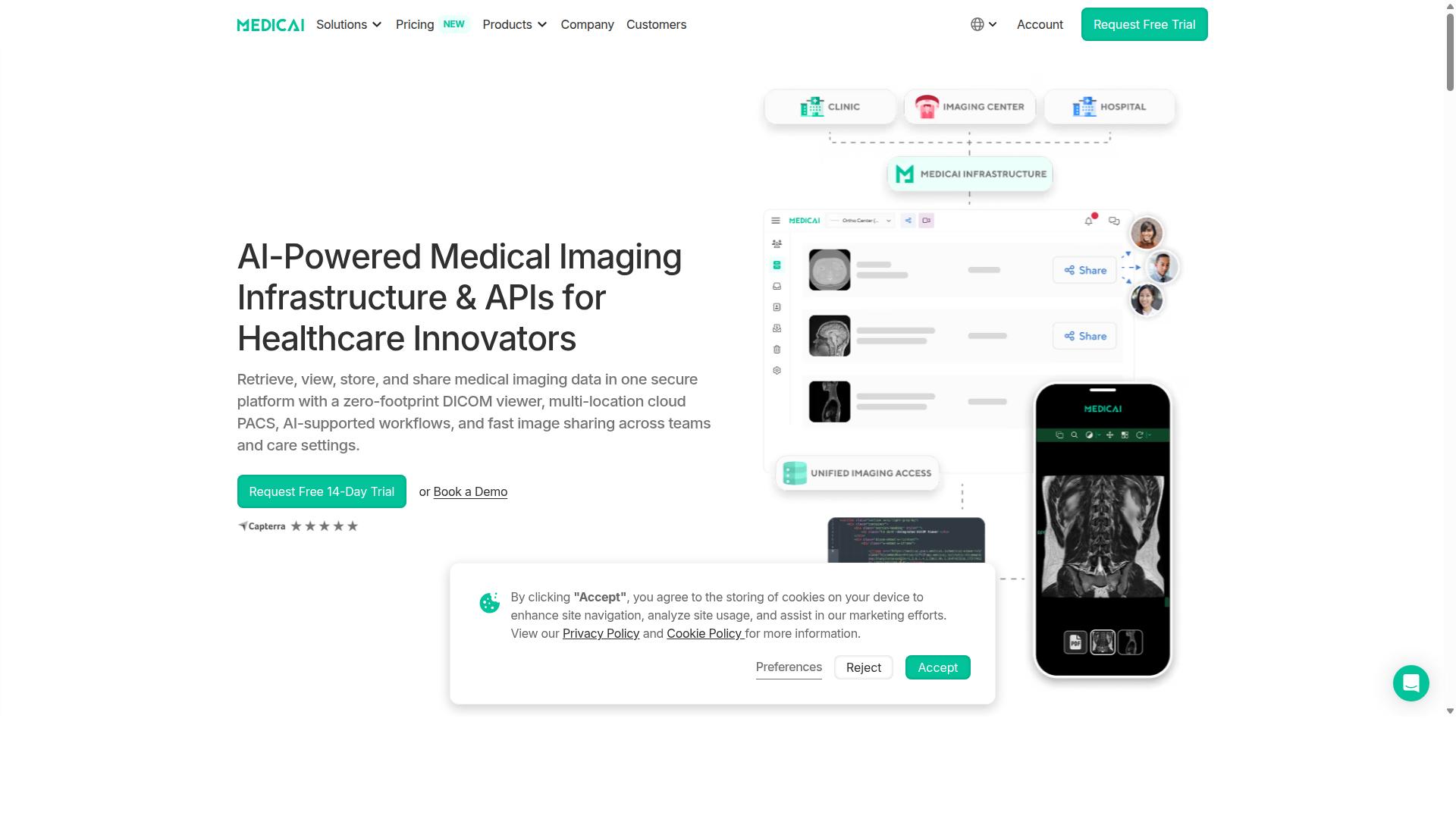
Medicai is a cloud-based medical imaging platform that gives healthcare providers one secure place to retrieve, view, store, and share imaging studies.
Core purpose centers on single-location access to imaging data. The platform includes a zero-footprint DICOM viewer and maintains HIPAA and GDPR compliance. The system processes more than one million studies each year.
Workflow begins with CONNECT and RETRIEVE. This phase uses the Medical Imaging Uploader and DICOM Gateway to pull studies from various sources into the platform.
Next comes STORE and MANAGE. The Cloud PACS and Vendor Neutral Archive hold data securely while supporting AI-assisted workflows and enabling interoperability across different care settings.
Finally, ACCESS, VIEW and COLLABORATE. The zero-footprint viewer allows real-time collaboration between team members across multiple locations without requiring local software installation.
Why Medicai Excels at Customizable Reporting
Customizable reporting in Medicai lets radiologists adapt templates and output formats to each clinical specialty without leaving the viewer. This flexibility supports medical imaging workflows across different departments.
Users can modify report templates to match specific departmental needs. Image annotations can be added directly to DICOM studies, while quantitative measurements integrate automatically into structured reporting fields.
Generated reports export in PDF format or HL7 FHIR structure for seamless interoperability. These export options ensure patient data reaches referring physicians through existing EMR integration pathways.
Oncology workflows benefit from lesion tracking across serial studies. Comparison studies in orthopedics show side-by-side measurements that highlight anatomical changes over time.
Structured Reporting for Radiology
Structured reporting within Medicai replaces free-text narratives with discrete, machine-readable data fields that improve diagnostic accuracy and longitudinal tracking. This approach helps radiologists move from lengthy paragraphs to organized templates that capture essential clinical details consistently.
Radiology departments benefit when reports follow standardized formats across different cases. Customizable reporting allows each facility to define which data points appear in every template while maintaining interoperability with existing EMR systems.
Medical imaging reports gain value when quantitative measurements and image annotations become part of the record. Structured reporting ensures these elements remain accessible for future comparison studies and automated analysis.
Zero-Footprint DICOM Viewer
The zero-footprint DICOM viewer lets radiologists open studies instantly in any browser and embed annotations or measurements directly into structured reports. This capability eliminates delays caused by software installations and supports immediate access to patient studies from any location.
Real-time lesion tracking becomes possible when radiologists can mark findings and record measurements without leaving the reporting interface. Automated measurements appear within the report structure, reducing manual entry while preserving accuracy.
The platform processed 300k+ visualizations of DICOM studies in the past year, demonstrating reliable performance across diverse clinical environments. Radiologists access these tools through standard web browsers without additional hardware requirements.
AI-Supported Workflows
AI-supported workflows in Medicai integrate third-party algorithms such as Rayscape.ai to pre-populate measurements and flag abnormalities within the structured report. These integrations reduce repetitive data entry while maintaining radiologist oversight of findings.
Comparison studies accelerate when AI models extract relevant data from prior examinations and present it alongside current measurements. Customizable reporting accommodates these automated inputs without disrupting established clinical workflows.
Rayscape.ai and similar models feed quantitative results directly into report templates. Radiologists review and adjust these values as needed, ensuring final reports reflect both algorithmic assistance and professional judgment.
Key Features and What Makes Medicai Stand Out
Medicai differentiates itself through deep interoperability, real-time collaboration, and native multi-specialty support in a single cloud workspace.
Its HL7 FHIR and DICOMweb APIs handle over 50 million transactions each year. This connectivity enables seamless data exchange between systems and supports structured reporting across specialties.
The platform integrates directly with existing EMR systems. Medical Imaging Uploader and DICOM Gateway tools connect imaging sources without disrupting current workflows.
Patient Case Management features allow teams to organize studies, images, and reports in one location. Shared access gives referring physicians instant visibility into patient data and annotations.
Cloud PACS and Vendor Neutral Archive services provide secure storage and retrieval. Backup and Disaster Recovery options protect imaging data while maintaining regulatory compliance.
Structured Reporting for Radiology and Doctor Imaging Portal tools support customizable report templates. The DICOM Viewer enables precise measurements and image annotations that feed directly into final reports.
Medicai also includes AI-Powered Diagnostics and Radiology AI Co-Pilot features. These additions assist with automated measurements and longitudinal tracking across multiple patient studies.
Patient Imaging Portal access lets individuals review their own medical images. Teleradiology and Tumor Boards support extend collaboration to external specialists when needed.
Pricing and Plans
Medicai offers transparent monthly subscriptions that scale storage and connected locations without charging per user.
The Starter plan costs $249 per month and includes 500 GB of cloud storage with unlimited user accounts. This tier supports zero connected locations.
The Standard plan is priced at $749 per month and provides 2 TB of cloud storage along with one connected location. Both plans allow unlimited users regardless of subscription level.
Overage storage fees follow a usage-based model that charges only for additional capacity beyond the included limits. Yearly billing reduces costs by 15 percent, bringing the Starter plan to $209 monthly and the Standard plan to $639 monthly.
Enterprise customers receive custom pricing with multiple connected locations and external site support. A free 14-day trial of Starter features is available without requiring a credit card.
Trust Signals
Trust signals such as regulatory clearances and uptime infrastructure give healthcare organizations confidence that Medicai meets strict data-protection standards.
Medical imaging platforms must demonstrate consistent reliability and regulatory compliance before healthcare organizations adopt them. Medicai delivers both through documented clearances and proven infrastructure partnerships.
Organizations processing medical imaging rely on measurable proof points rather than marketing claims. The platform processes over 1 million studies annually while maintaining 1.7 million studies in secure storage.
Healthcare providers need verification that their imaging platform meets current regulatory requirements. Medicai maintains these standards through documented compliance and infrastructure choices that support clinical workflows.
Compliance and Security
Compliance and security features include HIPAA and GDPR adherence, FDA and CE-cleared viewer, and encrypted storage on Microsoft Azure and Amazon AWS.
Medical imaging platforms handle sensitive patient data that requires multiple layers of protection. Medicai implements encryption for data both at rest and during transmission to maintain these protections.
Regulatory compliance forms the foundation for medical imaging adoption in clinical settings. The platform follows OWASP security guidelines and maintains FDA and CE-cleared viewers for diagnostic use.
Disaster recovery capabilities ensure continuous access to imaging studies when healthcare providers need them most. Microsoft Azure and Amazon AWS infrastructure provides the redundancy required for clinical operations.
The 1.7 million studies stored under these safeguards demonstrate the platform's capacity to handle large-scale medical imaging requirements while maintaining security standards.
Who Should Use Medicai
Hospitals, outpatient imaging centers, and specialty clinics that require secure, collaborative access to medical images are the primary users of Medicai.
Radiology departments use Medicai for structured reporting that standardizes findings across multiple modalities. Radiologists can capture quantitative measurements and image annotations directly within the viewer.
Oncology practices rely on Medicai for lesion tracking across serial studies. Tumor boards access the same case files simultaneously for treatment planning discussions.
Orthopedics clinics utilize Medicai to generate templated reports that include precise measurements for surgical planning. Referring physicians receive consistent documentation that supports operative decisions.
Cardiology departments apply Medicai to create comparison studies between echocardiograms and cardiac CT scans. Structured reporting ensures all measurements follow established guidelines.
Neurology practices depend on Medicai for longitudinal tracking of brain MRI findings. Reports capture evolving patterns across multiple time points for patient management.
Ophthalmology centers use Medicai to document retinal imaging findings with standardized templates. Quantitative measurements support treatment monitoring for chronic eye conditions.
OB-GYN practices generate fetal ultrasound reports through Medicai with automated measurements. Structured templates ensure complete documentation for prenatal care coordination.
Pulmonology clinics create chest CT reports with Medicai that track nodule changes over time. Comparison tools help monitor disease progression in lung patients.
Dentistry offices use Medicai for CBCT scan analysis and implant planning documentation. Reports include measurements that support surgical guide fabrication.
Gastroenterology practices document endoscopic ultrasound findings through Medicai with standardized reporting formats. Structured templates capture all necessary measurements for procedure documentation.
Final Verdict
For organizations seeking a HIPAA-compliant, zero-footprint viewer with structured reporting and global availability, Medicai provides a scalable, cost-predictable solution.
The platform combines a cloud-based DICOM viewer with PACS integration, enabling radiology teams to access patient images from any location. This setup supports clinical workflow by removing the need for local installations or complex IT setups.
Structured reporting features help radiologists maintain consistency across reports. Report templates and customizable fields allow teams to adapt documentation to specific specialties while preserving diagnostic accuracy and clarity.
Interoperability remains central to the design. HL7 FHIR standards facilitate EMR integration, helping referring physicians receive timely updates and collaborate on patient care without manual data transfers.
Medicai USA operates at 7901 4th St N, STE 300, St. Petersburg, FL 33702, reachable at +1 (832) 220 1035. Medicai Romania is located at 53-55 N Filipescu, 5th Floor, Sector 2, Bucharest 020961, with contact available through +40 316 305 875 or [email protected].
Recommended Resources: