
Why Is Medicai the Best for Highly Interoperable?
Quoted in this article$2,000 to $18,000
Most hospitals still juggle three separate systems to pull, store, and send scans between departments. Each extra hop adds hours of delay and extra risk of lost files.
By the end of this article, you will know exactly how Medicai's single cloud platform removes those hops, which departments gain the most from its built-in viewer and storage, and whether its Imaging Infrastructure as a Service fits your current workflow and budget.
What Is Medicai?
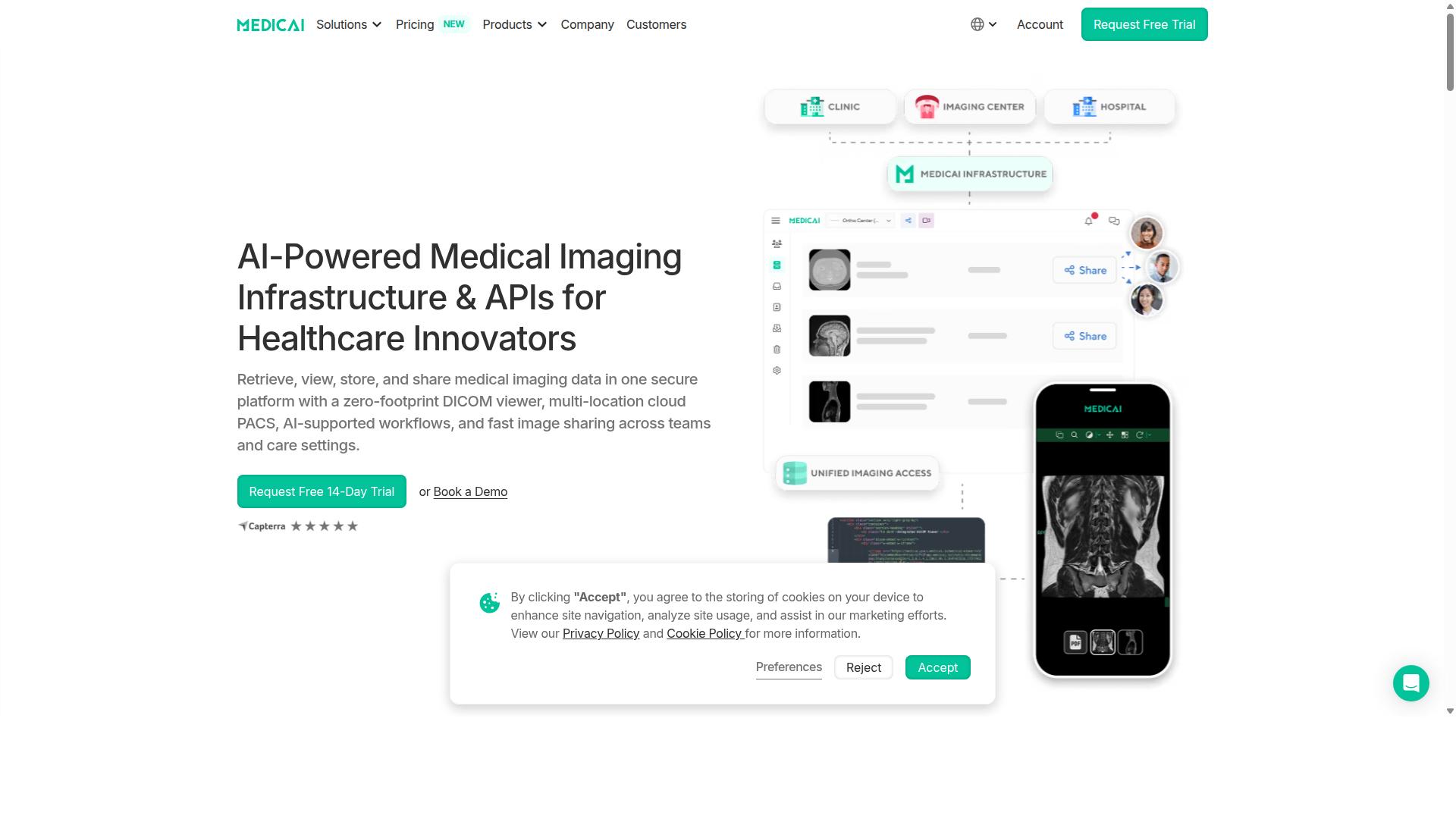
Medicai is a cloud-based medical imaging platform that handles DICOM files via a zero-footprint viewer. The solution combines imaging infrastructure as a service with tools that support modern clinical workflows across multiple care settings.
Core functions include retrieving, viewing, storing, and sharing medical imaging data within one secure workspace. This unified approach addresses common challenges in radiology and diagnostic imaging workflows.
The platform offers a multi-location cloud PACS that enables healthcare providers to manage imaging data across different facilities. AI-supported workflows help streamline routine tasks while maintaining compliance standards required in healthcare environments.
Fast image sharing across teams supports collaboration between specialists and care settings. This capability proves essential when patients receive treatment from multiple providers who need access to imaging studies.
By delivering Imaging Infrastructure as a Service, Medicai modernizes how medical imaging data moves through healthcare organizations. The vendor-neutral approach helps facilities avoid lock-in while maintaining interoperability with existing systems.
Why Medicai Is the Best for Highly Interoperable Medical Imaging
Interoperability across DICOM, HL7, and FHIR standards is the key differentiator for today's medical imaging workflows. Medical imaging platforms must exchange data seamlessly between imaging devices, electronic health record systems, and external applications. Modern healthcare organizations rely on this connectivity to deliver coordinated patient care across specialties and locations.
Effective integration eliminates the need for custom middleware and reduces implementation complexity. Standards-based connectivity allows radiology departments to send images directly to EHR systems while maintaining structured patient records. Real-time data exchange supports faster diagnostic decisions without manual file transfers or redundant data entry.
Healthcare providers benefit when imaging platforms communicate directly with existing systems rather than requiring additional integration layers. This approach reduces maintenance overhead and potential points of failure. Standards-based connections also support future scalability as organizations adopt new technologies or expand their service offerings.
Cross-platform compatibility extends to mobile devices and remote workstations. Clinicians can access imaging studies from various locations while maintaining security and compliance requirements. Structured reporting capabilities connect with existing documentation workflows to keep patient records complete and accurate.
Key Features and What Makes Medicai Stand Out
Three product pillars support the entire imaging lifecycle from upload to final report. Each component handles a distinct stage while remaining fully linked to the others. This structure ensures consistent data flow across the platform.
Healthcare organizations need tools that speak the same language. Medicai achieves this by aligning its modules with established standards. The result is a system that adapts to current workflows without forcing new ones.
Medical imaging departments face daily pressure to move studies quickly and safely. The three pillars address this pressure by dividing tasks into clear stages. Each stage maintains the same security and compliance practices.
CONNECT & RETRIEVE Tools
DICOM Gateway and Medical Imaging Uploader move studies from any modality into the cloud. The gateway accepts incoming studies from connected devices. It then tags the metadata and prepares each study for transfer.
Encrypted HTTPS or VPN connections carry the data to the cloud environment. This approach prevents exposure during movement between local systems and remote storage. Audit trails record every step of the transfer process.
The Medical Imaging Uploader accepts studies from various sources, including portable devices and external facilities. Once received, each study receives the necessary identifiers before it enters the storage layer. This preparation step supports later search and retrieval functions.
STORE & MANAGE Capabilities
Cloud PACS, Vendor Neutral Archive, and automated backup keep imaging data accessible and compliant. The Vendor Neutral Archive stores studies in a format that does not tie them to any single manufacturer. This independence supports long-term retention and future migrations.
Automated backup runs on a schedule that matches institutional requirements. Disaster recovery procedures follow documented SLAs that define recovery time and recovery point objectives. These measures protect against both hardware failure and regional outages.
Retention policies can be set per institution or per study type. Compliance records remain attached to each study throughout its lifecycle. This setup satisfies both HIPAA and GDPR requirements without manual intervention.
ACCESS, VISUALIZE, COLLABORATE Features
Zero-footprint DICOM viewers enable radiologists and referring physicians to review and annotate images from any browser. Live multi-user sessions allow several specialists to examine the same study at the same time. Annotations and measurements appear for all participants.
Structured Reporting for Radiology produces reports that can move directly into existing EMR or EHR systems. The Doctor Imaging Portal and Patient Imaging Portal give each user group appropriate access levels. Export functions preserve image quality while meeting file-size limits set by receiving systems.
The Medicai Imaging API and Mobile Imaging App extend these capabilities beyond the desktop. AI overlays can be added through the Radiology AI Co-Pilot when additional analysis is required. All access events remain logged for compliance review.
Pricing and Plans
Two subscription tiers meet the needs of both small practices and multi-site health systems. The pricing structure supports medical imaging workflows that demand reliable interoperability across different healthcare environments.
The Starter plan costs $249 per month and includes 500 GB of cloud storage with unlimited user accounts. This tier operates without connected locations, making it suitable for practices that handle imaging data independently.
The Standard plan costs $749 per month and provides 2 TB of cloud storage with unlimited user accounts and one connected location. This configuration supports practices requiring direct integration with external systems for seamless data exchange.
Yearly billing offers 15 percent savings on both tiers. The Starter plan drops to $209 monthly, while the Standard plan drops to $639 monthly when paid annually.
Enterprise pricing remains custom and accommodates multiple connected locations plus external connections. A one-time DICOM Gateway Setup fee of $1,000 applies per location for organizations requiring advanced connectivity options.
The 14-day free trial of Starter plan features requires no credit card. Per-study pricing options exist for enterprise customers who prefer usage-based billing over fixed monthly rates.
Trust Signals
HIPAA, GDPR, FDA, and CE clearances plus 50 M+ annual API transactions demonstrate enterprise-grade security. These compliance milestones ensure organizations can exchange patient records across systems without exposing sensitive data.
OWASP security guidelines followed by the platform add another layer of protection during medical imaging workflows. Encryption standards meet requirements for both cloud storage and real-time data exchange across PACS and EHR environments.
Third-party audits verify that every DICOM study, HL7 message, and FHIR resource follows established protocols. These reviews confirm the system maintains audit trails and access controls that align with vendor-neutral archive expectations.
Microsoft Azure partnership supports scalability for 1M+ studies transacted or processed per year. The infrastructure handles 2M+ imaging studies uploaded while preserving performance for 10,000+ active doctors across 70 clinics and hospitals.
Security architecture spans multiple geographies, enabling secure transfer for global multidisciplinary tumor boards. This reach supports patients who need cross-border collaboration without compromising regulatory standards.
Who Should Use Medicai
Hospitals, imaging centers, and specialty providers across ten clinical domains rely on the platform.
Radiology departments use the system for seamless PACS integration and rapid image sharing between facilities. A radiologist receives DICOM studies directly from remote scanners and generates structured reports that populate the EHR automatically.
Cardiology teams benefit from standardized data exchange when reviewing echocardiograms and cardiac CT scans. The platform pulls HL7 messages from the EMR while the viewer displays cine loops with no manual file transfers.
Orthopedics practices depend on fast access to prior radiographs and MRI studies before joint replacement procedures. Surgeons pull images from the archive through the viewer and compare them side-by-side with current studies.
Neurology departments manage complex stroke and brain tumor workflows through unified patient records. Specialists review serial MRIs in real time and coordinate treatment plans across multiple sites without leaving their dashboard.
Oncology centers coordinate tumor board meetings by gathering imaging, pathology, and lab data in one secure location. The system supports cross-specialty collaboration while maintaining compliance with HIPAA and GDPR requirements.
Ophthalmology clinics exchange retinal scans and OCT images with referring optometrists through encrypted channels. The cloud viewer renders high-resolution files on mobile devices for on-call consultations.
OB-GYN providers share fetal ultrasound studies and growth charts with maternal-fetal medicine consultants. Patient portals allow expectant mothers to view images and reports from any device.
Pulmonology groups review chest CTs and pulmonary function tests within the same workflow. AI tools highlight suspicious nodules while the structured reporting module captures findings directly into the EMR.
Dentistry practices store panoramic radiographs and cone-beam CT volumes in a vendor-neutral archive. Referring dentists retrieve studies through the secure portal without needing specialized software.
Gastroenterology units integrate endoscopy videos with radiology reports for comprehensive patient assessments. The platform supports both live streaming during procedures and post-procedure review sessions.
Final Verdict
Medicai delivers a standards-based, globally available imaging platform backed by measurable performance metrics. The platform supports DICOM, HL7, and FHIR exchange across PACS, EHR, and EMR systems. This ensures healthcare providers receive consistent access to patient records regardless of their existing infrastructure.
Organizations that need vendor-neutral archive capabilities benefit from the ability to connect multiple systems without proprietary lock-in. Medical imaging data flows between departments, specialties, and even different healthcare institutions through standardized protocols. This reduces friction during referrals and cross-facility collaboration.
Compliance with HIPAA and GDPR requirements remains central to the architecture. Encryption, access controls, and audit trails protect sensitive medical imaging throughout transfer and storage. Healthcare IT teams gain confidence that patient data stays secure while remaining accessible to authorized users.
Scalability comes from cloud infrastructure that adjusts to varying imaging volumes. Real-time access extends to mobile devices, allowing physicians to review studies at the point of care. Structured reporting and image sharing features streamline workflows across multi-specialty teams.
Medicai USA
7901 4th St N, STE 300
St. Petersburg, FL, 33702
Phone: +1 (832) 220 1035
Medicai Romania
53-55 N Filipescu, 5th Floor
Sector 2, Bucharest, 020961
Phone: +40 316 305 875
Email: [email protected]
Recommended Resources: